
In assocciation with Kalahari Wildlife Tours
14 DAY KGALAGADI WILDLIFE & NAMAQUALAND FLOWERS TOUR – 12-25 AUGUST 2026
KGALAGADI – AUGRABIES FALLS & NAMAQUALAND FLOWERS 2026
GUIDED PHOTOHRAPHIC TOUR – SCHEDULED DEPARTURE
WEB COPY
14 DAYS – 13 NIGHTS
THIS TOUR GOES TROUGH A MALARIA FREE AREA!
Green = Parks & Reserves
Blue = Places of interest
Red = Optional activities



KALAHARI TOURS & TRAVEL
IN ASSOCCIATION WITH KALAHARI WILDLIFE TOURS
TOUR SUMMARY:
DAY 01 12/08 Upington – Kgalagadi Transfrontier Park / Twee Rivieren – Family Cottage
DAY 02 13/08 Kgalagadi Transfrontier Park / Kalahari Tented Camp – Desert Tent
DAY 03 14/08 Kgalagadi Transfrontier Park / Nossob – Riverfront Chalet
DAY 04 15/08 Kgalagadi Transfrontier Park / Nossob – Riverfront Chalet
DAY 05 16/08 Kgalagadi Transfrontier Park / Mata Mata – Riverfront Chalet
DAY 06 17/08 Kgalagadi Transfrontier Park / Twee Rivieren – Family Cottage
DAY 07 18/08 Augrabies Falls National Park / Rest Camp – Chalet
DAY 08 19/08 Augrabies Falls National Park / Rest Camp – Chalet
DAY 09 20/08 Namaqualand / Goegab Nature Reserve / Springbok Inn – Room
DAY 10 21/08 Namaqua National Park / Hondeklip Bay / Honnepondokkies – Chalet
DAY 11 22/08 Namaqua N P Coastal Section / Hondeklip Bay / Honnepondokkies – Chalet
DAY 12 23/08 Namaqualand / Bird Island / Lambert’s Bay Hotel – Room
DAY 13 24/08 West Coast Nat Park / Cape Town – City Lodge Waterfront – Room
DAY 14 25/08 Cape Town & Surrounds – Depart
Pre-tour accommodation in Upington can be booked and added to RATES on request
DETAILED ITINERARY
DAY 01 12 Aug Upington – Kgalagadi Trans Frontier Park / Twee Rivieren
Time of departure will depend on clients’ travel schedule to Upington. Flight schedule to be finalised. (Flight not included)
Depart from Upington in 02 x 4×4 Double Cab/SUV vehicles on a 03-hour drive through the Kalahari duneveld (“veld” means natural vegetation), passing various pans (dry lakes), to the Kgalagadi Trans Frontier Park.
The word Kalahari derives from the word Makgadigadi, meaning salt pans (salt lakes) in the language spoken by the Kgalagadipeople living in the Kgalagadi Region in south-western Botswana. The word Kgalagadi means salt pans too in their language. More than 1 000 pans are scattered throughout the park. The Kalahari is the largest area of sand in the world, covering 2.5 million square kilometres from the Orange River in South Africa in the south to slightly north of the equator.
The area referred to as the arid Kalahari covers some 900 000 square kilometres in the south and covers parts of South Africa and Namibia and most of Botswana. The Kgalagadi Transfrontier Park is situated in the southern part of the arid Kalahari in South Africa and Botswana and is jointly managed by South Africa National Parks (Sanparks) and Botswana Wildlife.
The Kgalagadi Transfrontier Park covers 37 000 square km, which is one of the largest conservation areas in the world and one of the last truly unspoilt ecosystems.
Endemic game such as gemsbok, springbok, eland, giraffe, blue wildebeest and red hartebeest roam the sparsely vegetated red sand dunes and the dry river valleys of the Nossob and Auob where a variety of acacia species thrive.
The Park is well known for good sightings of lion, leopard and cheetah and spotted – and brown hyena are common residents. Because of an abundance of prey in the form of mice, whistling rats, birds and insects, smaller predators thrive in the park. The park is home to caracal, honey badger, black-backed jackal, bat-eared fox, cape fox, African wildcat, mongoose and the ever-popular suricate (meerkat).
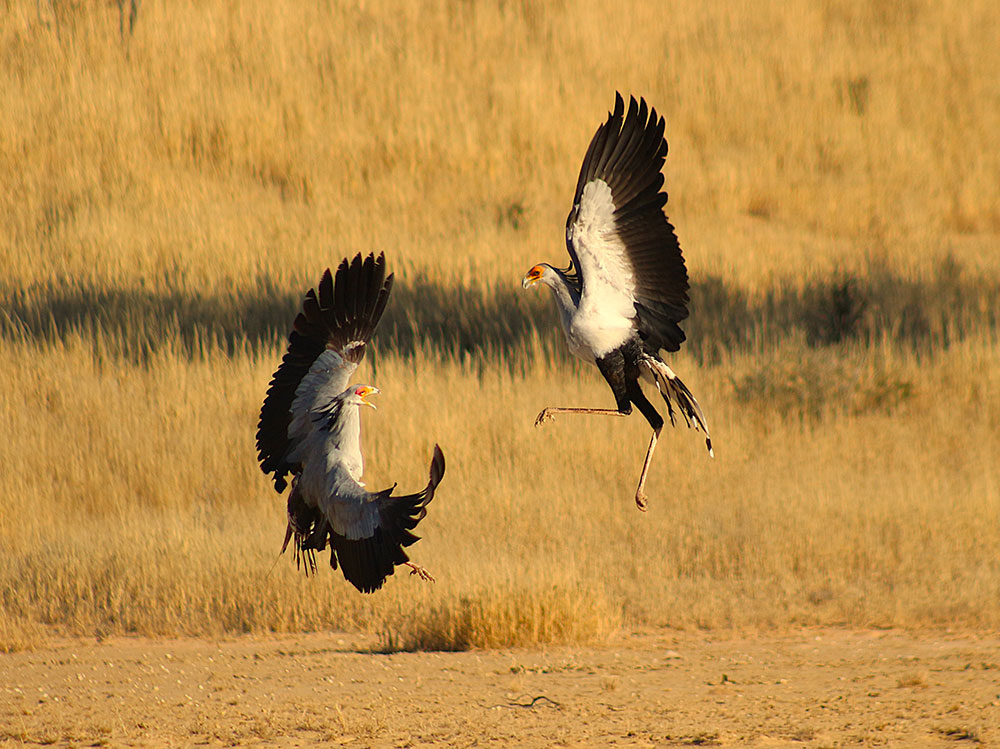
Kgalagadi is a bird watcher’s paradise with more than 300 species recorded including at least 20 larger raptor species. The world’s heaviest flying bird, the Kori bustard and the stately secretary bird patrol the riverbeds while the noisy northern black korhaan rule in the dunes.
En route stop at Andriesvale at the last indigenous San tribe in South Africa, the Khomani. Today these earliest residents of the Kalahari, living here for 40 000 years, consist of only 400 people and are resident in an area between 40 and 70 km south of Twee Rivieren. Clients will have the opportunity to view and purchase their handcraft at one of the roadside stalls. (The presence of the San at the roadside stalls can’t be guaranteed.)
Check in at Twee Rivieren Reception. Wild Cards for International Guests are purchased to cover Entrance Fees. (Included). Check in at accommodation from 14:00, check-in time at all Camps.
Depart on an afternoon game drive. The Twee Rivieren area is known for lion, leopard, cheetah and meerkat sightings. Twee Rivieren has an illuminated waterhole on top of a dune. Predators and antelope visit the waterholes regularly.
Optional 3 hr sunset drive and 2 hr night drive with Sanparks guide on open game drive vehicle at own cost at all camps @ R440 pp
Overnight: 04 x Family Cottage at Twee Rivieren + Crew Cottage
Meals: B, L & D (Full Board on all days)
DAY 02 13 Aug Kgalagadi Trans Frontier Park / Kalahari Tented Camp
Depart on a morning game drive along the Auob River Valley to Kalahari Tented Camp 03 km from Mata Mata Rest Camp.
This is cheetah territory and is one the best, if not the best, places in Southern Africa to see cheetah. The Mata Mata area is also known for lion, hyena and giraffe sightings.
Situated high up on a red sand dune, overlooking a waterhole in the dry bed of the ancient Aoub River, the Kalahari Tented Camp welcomes you to capture the spirit of the thirst land. The luxurious wilderness camp offers an exclusive getaway for the discerning visitor. Good wildlife sightings are common in the area.
Time at leisure.
Depart on an afternoon game drive until gate closes.
Overnight: 04 x Twin Desert Tent at Kalahari Tented Camp + Crew Tent
DAY 03 14 Aug Kgalagadi Trans Frontier Park / Nossob
Morning game drive to Nossob Rest Camp along the Auob River, Upper Dune Road and Nossob River Valley.
Nossob Rest Camp is situated on the bank of the Nossob River bed. The Nossob area is known for lion activities and brown hyena sightings. Good sightings of a variety of raptors are guaranteed. Nossob has an illuminated waterhole. Predators and antelope are regular visitors. Various owl species are regular sightings in Nossob Camp.
Time at leisure.
Depart on an afternoon game drive until gate closes. The nearby loop road Marie se Draai is a popular drive.
Overnight: 04 x Twin Riverfront Chalet at Nossob + Crew chalet
DAY 04 15 Aug Kgalagadi Trans Frontier Park / Nossob
Morning game drive north to Lijersdraai Picnic Area. Return to Nossob at noon. Quibitjie Quap and Polentswa Waterholesare popular with raptors, due to less salty water.
Time at leisure.
Depart on an afternoon game drive until gate closes.
Overnight: 04 x Twin Riverfront Chalet at Nossob + Crew chalet
DAY 05 16 Aug Kgalagadi Trans Frontier Park / Mata Mata
02-Hour morning game drive in Nossob Area.
Depart along the Nossob River Valley, Upper Dune Road and Auob River Valley to Mata Mata Rest Camp, situated on the bank of the dry Auob River bed, on the Namibian Border. This is cheetah territory and is one the best, if not the best, places in Southern Africa to see cheetah. The Mata Mata area is also known for lion, hyena and giraffe sightings.
Mata Mata has an illuminated waterhole. Predators and antelope are regular visitors. There is a resident mob of meerkat in and around Mata Mata.
Time at leisure.
Depart on an afternoon game drive until gate closes.
Overnight: 04 x Twin Riverfront Chalet at Mata Mata + Crew chalet
DAY 06 17 Aug Kgalagadi Trans Frontier Park / Twee Rivieren
Morning game drive along the Auob River Valley to Twee Rivieren.
Time at leisure.
Depart on an afternoon game drive until gate closes.
Overnight 04 x Family Cottage at Twee Rivieren + Crew Cottage
DAY 07 18 Aug Kgalagadi – Augrabies Falls National Park / Rest Camp
Depart to Upington when gate opens.
Continue to Augrabies Falls National Park, which covers 60 000 ha. En route visit to Tierberg Nature Reserve in Keimoes, from where one has a beautiful view of the lush green Orange River Valley. Continue to Kakamas. Stop at Die Pienk Padstal(The Pink Road Stall) which stocks a variety of dried fruit products and local delicacies.
Wine tasting optional at the Orange River Wine Cellar in Kakamas, the second largest cooperative wine cellar in the world. Except for wine and grape juice production, the lower Orange River Valley is the major raisin production area – and one of the major table grape production areas in South Africa.
Proceed to Augrabies Falls National Park. Visit the Augrabies Falls, which is the sixth largest waterfall in the world when South Africa’s largest river, the Orange is in flood. The word Augrabies derives from the Khoi meaning “Place of great noise”. Although Augrabies is essentially a scenic park, game such as giraffe, springbok, gemsbok, eland, kudu red hartebeest, Hartman’s zebra and klipspringer survive in this unique riverine ecosystem. Fish eagles and black eagles are common residents and the Rest Camp is home to a variety of bird species.
Do a scenic game drive in this moon landscape-like land to awesome viewpoints such as Ararat, Oranjekom on the Orange River Gorge and the “Swartrante” (Black Hills) from where one has a great view of this arid rocky desert landscape.
The fall is illuminated from 20:00 22:00. Guests can re-visit the fall at their own time and pace.
Optional 2 hr sunset drive with Sanparks guide
Overnight: 04 x Twin Chalet at Augrabies Rest Camp + Guide Chalet
DAY 08 19 Aug Augrabies Falls National Park / Rest Camp
Do a relaxed 2km morning walk to a beautiful viewpoint on the Augrabies gorge, Arrow Point.
Do a scenic game drive in this moon landscape-like land to awesome viewpoints such as Ararat, Oranjekom on the Orange River Gorge and the “Swartrante” (Black Hills) from where one has a great view of this arid rocky desert landscape.
Continue on a circular drive to the Western Section, where the chances are good to see Hartmann’s mountain zebra and eland. There are many quiver trees along this route.
Afternoon at leisure. Augrabies Falls can be explored in full along the stilted walkways and viewpoints.
Overnight: 04 x Twin Chalet at Augrabies Rest Camp + Guide Chalet
DAY 09 20 Aug Augrabies – Springbok (Namaqualand)
Depart to Springbok. Visit Goegab Nature Reserve 15 km from Springbok. Goegap features most of Namaqualand’s natural riches in 15 000 ha of typically granite, rocky hills and sandy flats. It supports close to 600 indigenous flower species, 45 mammal species, 94 bird species and several species of reptile and amphibian.
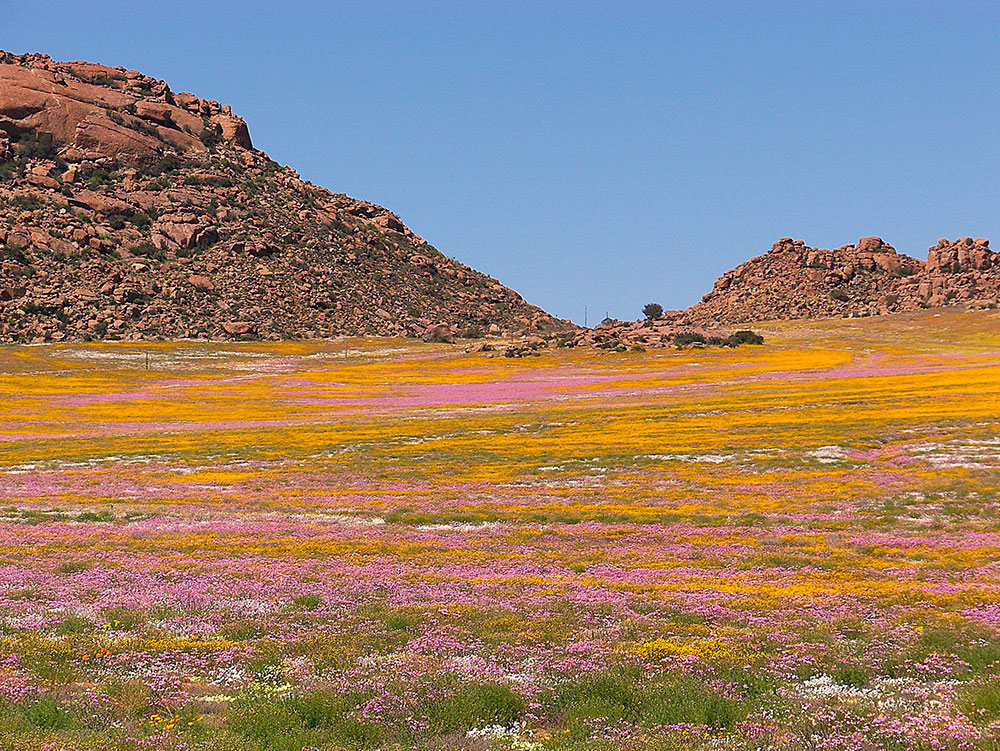
Various species of Mesembryanthemum, Gazania, Ostespermum, Dimorphoteca Aptosium and many more species can be seen. Many species, known as daisies locally, covers the landscape after good winter rains.
The Hester Malan Wild Flower Garden is a spectacular additional feature, showcasing many Namakwa succulents and a rock garden.
Explore Goegab on flower drive and short walks.
Return to Springbok, the main town of Namaqualand. No visit to Springbok is completed without visiting the Springbok Lodge. The history of Springbok and the copper mining industry are displayed on the walls and the huge collection of gemstones of the owner Mr Jopie Kotze is on display too. A great variety of books are sold, especially from local writers, some specially reprinted on Mr Kotze’s request as well as a variety of coffee table books and nature guides. This is also the get together place for flower lovers, where information is gathered and exchanged, about the best wild flower spots.
Overnight: 04 x Room at Springbok Inn + Guide Room
DAY 10 21 Aug Springbok – Hondeklip Bay (Namaqua National Park / Skilpad)
Depart to Skilpad Wild Flower Reserve in the Namaqua National Park. Namaqua National Park is situated in the world’s only arid biodiversity hotspot. Namaqualand is home to more than 6000 plant species, 250 species of birds, 78 species of mammals 132 species of reptiles and amphibians and an unknown number of insects, making it the world’s most diverse arid environment. More than 40% of these species are found nowhere else on earth.
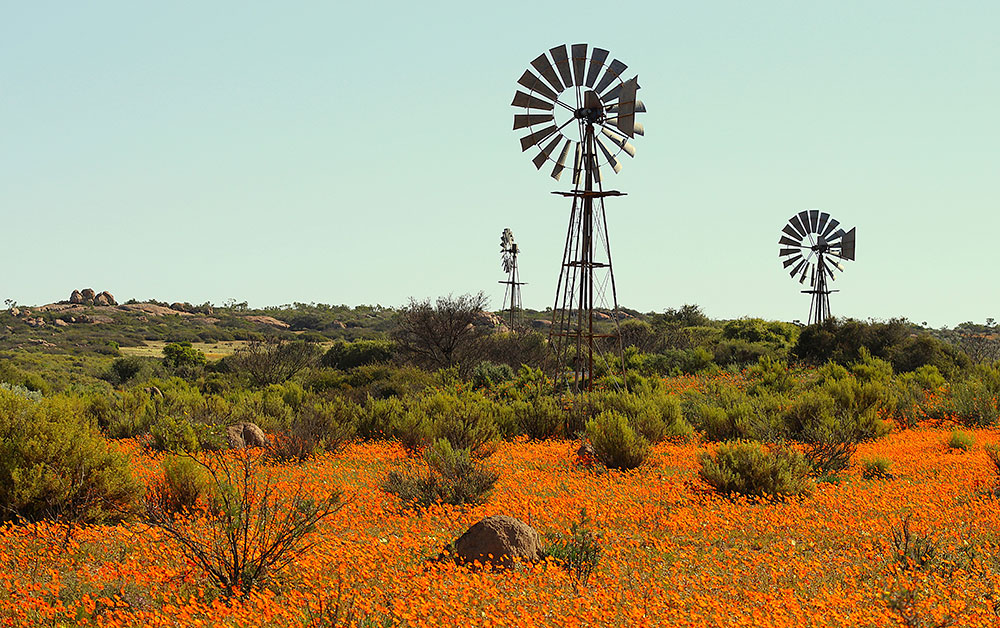
Skilpad is known for its orange carpets of Namaqualand daisies. White, orange and yellow Namaqualand daisies grow wild in the Skilpad Nature Reserve. Other plants of interest include small bulbous plants, better known as Vygies (Mesembryanthemum), produces bright pink flowers. The 5 km dirt road that circles the reserve will offer fantastic views of the springtime flower show.
Continue on 4×4 trail through the Park to Soebatsfontein Gate. Proceed to Hondeklip Bay on the West Coast, which relies for its survival on a small crayfish industry and a few diamond boats operating from its harbour. This small remote seaside village has an unpretentious rural charm.
The Namaqulaand West Coast always have spring flowers, even in years with low rainfall. Most of the plants get their moisture from the fog moving in overnight.
Visit the wreck of the Aristea, 05 km south of town. The Aristea was once a fishing trawler belonging to I&J. It was built in 1934 in Scotland and was first a coal trawler, taken over by the South African Navy in November 1939 for the duration of WW11 until December 1944, when it was handed back to its owners. It survived WWII, but not the mishandling by her drunk captain along the shores of Hondeklip Bay. She ran aground on the 4th July 1945. The captain was too drunk to take control of the ship in rough seas, just off the coast. In that stormy night a junior deckhand swam ashore with a rope to save his fellow sailors. From a crew of 24, one lost his life.
Overnight: 04 x Chalet at Honnepondokkies + Guide Chalet
DAY 11 22 Aug Hondeklip Bay (Namaqua National Park / Coastal Section)
Enter the Coastal Section of the Namaqua National Park. Continue south on the Caracal 4×4 Trail. The trail runs through impressive West Coast landscapes with spring flowers and excellent photographic and bird watching opportunities, including the rare black oystercatcher.
The scenic Spoeg River Estuary is an excellent birding spot, particularly for waders. The Spoegrivier Caves are a historical and cultural landmark, where the earliest signs of sheep farming in South Africa, 2000 years ago, was found.
Visit the Cape fur seal breeding colony near Bouldersbaai. Thousands of seals can be seen basking in the sun and wading in the waters off the beach. Breeding Cape Cormorants share their perch with the seals. While travelling along the coast, look out for heavyside dolphins, which is endemic to the West Coast.
The trail crosses the Bitter River Dunes (sand movement corridor). This is a good example of a dynamic, moving dune system. This particular system is in pristine condition, and the only unspoilt and properly functioning system left on the South African coast. The system stretch over 20 km and is protected in its entirety and is a major conservation feature of the park. The dunes offer a haven for breeding pairs of ostriches.
Return in the afternoon to Hondeklip Bay.
Enjoy a local delicacy, crayfish (rock lobster) at dinner
Overnight: 04 x Chalet at Honnepondokkies + Guide Chalet
DAY 12 23 Aug Hondeklip Bay – Lambert’s Bay
Continue inland on a flower drive through a remote section of the Namaqualand to the small town Garies.
Depart south on the N7 through the Namaqualand via Bitterfontein and Nuwerus to Vanrhynsdorp. The Knersvlakte near Vanrhynsdorp can have excellent flowers after good winter rains.
Visit the Kokerboom Nursery in Vanrhynsdorp (at the edge of the Nama Karoo in the Western Cape). It was established during a time that the N7 was being built, destroying millions of succulents in the process.
The owner, Mr Wiese seized the opportunity to save these plants, after receiving permits from Nature Conservation. He relocated the nursery from the Knersvlakte to its current position in Vanrhynsdorp and established it as a nature reserve, which remains in the Wiese family.
Continue to Lambert’s Bay. Visit Bird Island, which lies about 100 m off-shore of Lambert’s Bay on the Cape West Coast. The island, almost three hectares in size, is connected to the mainland via a breakwater. It is an important breeding and roosting site for seabirds, particularly Cape gannets and cormorants. African penguins used to be common on the island, and Cape fur seals still frequent the rocks on the sea side of the island. Bird Island is one of only six sites world-wide where Cape gannets breed, and it is also the only breeding site easily accessible to the public. In the modern gannet lookout, visitors can get close to the birds and witness the unique mating dances and vocalizing of the thousands of gannets on their nests.
Overnight: 04 x Room at Lambert’s Bay Hotel + Guide Room
DAY 13 24 Aug Lambert’s Bay – Cape Town
Depart to Velddrif. This fishing village on the Berg River is well known for its ‘Bokkom’ (dried fish), a West Coast delicacy. Do a drive down Bokkomlaan (Bokkom Avenue).
Continue to Paternoster. Paternoster is a sought after tourist destination and is known for lobster and the white-washed fishermen’s cottages. The remarkable coastline of jagged cliffs and white boulders makes this one of the most beautiful beaches on the West Coast of South Africa.
Proceed to the West Coast National Park. The park surrounds the Langebaan Lagoon, which is a world Ramsar site (sites deemed to be of global significance to wetland bird species). Thousands of seabird’s roost on sheltered islands and brooding salt marshes are home to vast concentrations of migrant waders from the northern hemisphere. Eland and Bontebok are see quite often in the western section of the park.
During spring the park is one of the best flower areas in the winter rainfall region of South Africa. Do a scenic flower drive through the park.
Do a flower drive through the park.
Depart to Cape Town. Check in at accommodation near the V&A Waterfront.
Overnight: 04 x Room at City Lodge Waterfront + Guide Room
DAY 14 25 Aug Cape Town & Surrounds
Depart on a tour of the Cape Peninsula. Visit the Penguins at Boulders. This colony of African (Jackass) penguins is one of only three colonies on the mainland. All other colonies are on islands. The first pair at Boulders was spotted in 1983 and since then the numbers have grown to about 3 000. Walkways ensure good close-up sightings of the penguins. Time for shopping at the souvenir shops and African Craft Market.
Continue to Cape of Good Hope & Cape Point which are all part of the Table Mountain National Park. The Table Mountain National Park is rich in floral biodiversity and is part of the Cape Floristic Region World Heritage Site. The most common vegetation type is fynbos and eland, bontebok, Cape mountain zebra, klipspringer and grysbok can be seen in the Cape of Good Hope section.
At Cape Point, visitors are treated to excellent viewing opportunities from both lighthouses that adorn the most south western point in Africa, one still fully functional. The lighthouse is accessible by foot or one can catch the Flying Dutchman funicular (at own cost) to the top.
Time for shopping at the souvenir shop.
Depart to the scenic Chapman’s Peak Drive. Chapman’s Peak Drive winds its way between Noordhoek and Hout Bay on the Atlantic Coast on the south-western tip of South Africa. Chapman’s Peak Drive is one of the most spectacular marine drives in the world.
The 9km route, with its 114 curves, skirts the rocky coastline of Chapman’s Peak (593m). Chapman’s Peak Drive is affectionately known as “Chappies” and is a must for anyone who is passionate about the majestic Cape Town scenery, with sheer drops to the sea below and towering mountains rising above you. The twists and curves in the road seem endless and it is a photographers dream. The drive offers stunning 180° views with many areas along the route where you can stop and take in the exquisite scenery.
ALTERNATIVE ACTIVITIES
Boulders & Cape Point can be replaced with visits Robben Island and Table Mountain at no additional costs.
Drop-off at accommodation or at Cape Town International to be in time for departing flight in the afternoon/evening. Flight schedule to be finalised. (Flight/accommodation not included)
Drop-off one rented vehicle.
TOUR PRICE:
Please contact us for Tour Price at
Office: dantes@kalahari-tours.co.za
Direct: liebenbergdantes@gmail.com
Whatsapp: +27 82 579 3344 (Dantes) / +27 68 851 2458 (Dennis) / +27 82 493 5041 (Elize)
Please specify if you are a SADEC Citizen or International visitor. Different rates apply at National Parks & Game Reserves.
INCLUDED:
01-03 x Air-con 4×4 Double Cab/SUV vehicles & fuel
Accommodation as per itinerary
Conservation Fees & Entrance Fees to Reserves
Meals as per itinerary (Full board; See MEALS below)
Bottled water & soft drinks
Activities as per itinerary (All scheduled game drives are in the tour vehicles)
Guidebooks about flora, fauna, area etc & maps in guide vehicle
15% VAT
EXCLUDED:
Flights
Accommodation pre/post tour in Upington & Cape Town if needed.
Alcoholic and after hours private drinks
Travel insurance (To be obtained in country of residence)
Any activities not included in tour itinerary
All accommodation, activities in red.
MEALS
Meals are provided in restaurants where available or prepared by the guide or crew member. Coffee/tea and a light breakfast are provided before early morning departures on game drives, followed by a brunch at a picnic area. On a normal schedule breakfast and light lunches are provided in restaurants or by guide/crew member. Dinners are in restaurants or catered by guide/crew member and on some occasions it will be a typical South African Braai (BBQ). Coffee/tea, juice, soft drinks & bottled water are included with all meals.
It is important to inform Kalahari tours and Travel in advance of any special dietary requirements!
CLIENTS NEED:
Binoculars, sun block, hat, closed shoes for evenings (scorpions), insect repellent, torch light or head light
INFORMATION NEEDED:
State of health and any dietary requirements (vegetarians, vegans etc.)
Please contact us if you need more information.
Kalahari Tours & Travel
Dantes Liebenberg
quick menu
NATIONAL PARKS & RESERVES
contact us
KALAHARI SAFARI
TOURS & TRAVEL
Upington 8801
TEL/FAX: + 27 (0) 54 3380375
CELL: + 27 (0) 82 4935041